7 Best Pipe Making Machines for Global Buyers
Choosing a pipe making machine is less about chasing the highest speed and more about matching equipment to the product, material, and daily workload. A line built for large-diameter steel pipe may be a poor fit for thin-wall tubing. Buyers should compare forming method, pipe diameter range, wall thickness, output rate, changeover time, and automation level. These details shape production long after installation.
This guide reviews seven machine categories for global buyers, from ERW and spiral pipe lines to stainless-steel tube mills and plastic pipe extrusion systems. Each option serves different production needs. The right choice depends on the target market, available floor space, operator skills, and access to replacement parts. Ask suppliers for sample weld records, finished-pipe measurements, and references from comparable installations. A polished brochure is useful, but it cannot show every shift-floor problem.
For transparency, the following is an illustrative comment, not a verified quotation, from fictional pipe-production specialist Daniel Mercer: “A machine earns trust when its output stays steady across a full shift.” That is the practical test. Check how the line handles start-ups, size changes, and routine maintenance—not only its best advertised speed. The details matter. Even a well-specified machine can disappoint when training, tooling, or service support is overlooked. No single ranking fits every buyer, and this comparison should be treated as a starting point for careful evaluation.
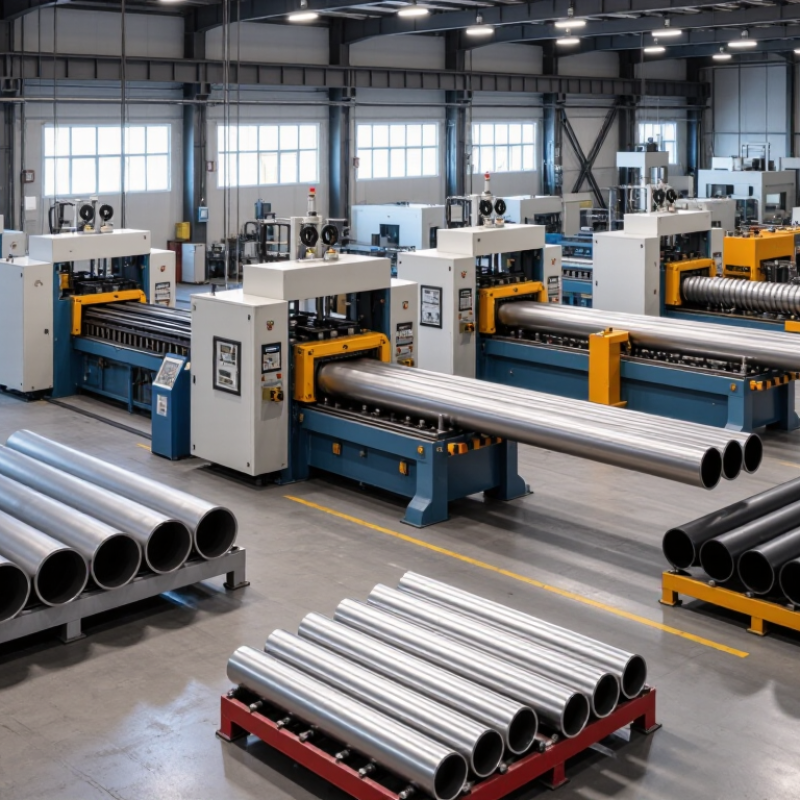
Seven Pipe-Making Machine Types: ERW, LSAW, SSAW, Seamless, PVC, HDPE, and Ductile Iron
Choosing a pipe-making machine starts with the pipe’s material, diameter, wall thickness, and intended service. ERW machines form steel strip into a tube and weld its edges, often using high-frequency resistance welding. They suit consistent production runs. LSAW machines shape steel plate and make a straight longitudinal seam, commonly for large-diameter, thick-wall pipe. SSAW machines form a spiral seam from steel strip, allowing diameter changes without replacing the entire forming section. Weld tracking and inspection still need careful attention.
Seamless pipe machines heat and pierce a solid billet, then roll it into a hollow tube. They avoid a longitudinal weld, but billet quality, sizing accuracy, and operating cost remain important. PVC machines extrude heated plastic through a die and use vacuum sizing and cooling tanks to hold the pipe’s shape. HDPE lines also extrude plastic, with downstream cooling and cutting equipment matched to the required diameter. Fusion compatibility matters. A fast line is not automatically a good fit.
Ductile iron pipe equipment typically centers on centrifugal casting, followed by heat treatment, finishing, and lining or coating operations. The process needs space and robust handling equipment. Buyers should compare changeover time, power demand, scrap rates, and access to maintenance support, not just rated output. Ask suppliers to demonstrate a run using comparable material and dimensions. Real production conditions can expose gaps that a polished specification sheet misses. I would verify those details before committing.
Seven Pipe-Making Machine Types by Primary Manufacturing Route
The chart groups the seven pipe types by their primary manufacturing route: ERW, LSAW, and SSAW are welded steel pipes; seamless pipe is made without a longitudinal weld; PVC and HDPE pipes are formed by extrusion; and ductile iron pipe is commonly made by centrifugal casting. Counts indicate the number of types in each group, not market share or production capacity.
Steel Pipe Mills: API 5L Grades from X42 to X80
For global buyers, a pipe mill must match its forming and welding process to the required API 5L grade. X42 specifies a minimum yield strength of 42 ksi, about 290 MPa; X80 raises that threshold to 80 ksi, about 552 MPa. These are not pressure ratings. Wall thickness, pipe diameter, service conditions, and the applicable standard edition also affect selection. Small defects matter.
ERW and submerged-arc-welded mills need different process controls, especially as strength rises. Buyers should check forming accuracy, weld procedures, heat treatment where required, and documented nondestructive testing. Higher strength can reduce steel weight in some designs, but it can also tighten demands on weld quality and toughness. A faster line is not automatically a better line. The World Steel Association’s World Steel in Figures 2024 reports 1,892.2 million tonnes of global crude steel production in 2023. That scale supports a broad material supply, not uniform pipe quality. Ask suppliers for grade-specific inspection records and traceability, then verify them against the project specification. Even experienced buyers can overlook this step.
Seamless Pipe Mills: ASTM A106 Grades A, B, and C
Seamless pipe mills for ASTM A106 service must control billet heating, piercing, wall reduction, and final sizing. The specification covers seamless carbon-steel pipe for high-temperature service. Its mechanical-property tables set minimum tensile strengths of 48,000 psi for Grade A, 60,000 psi for Grade B, and 70,000 psi for Grade C. Minimum yield strengths are 30,000, 35,000, and 40,000 psi, respectively (ASTM A106/A106M). Grade C’s higher strength is not a substitute for checking the project’s temperature, pressure, and design requirements. Small differences matter.
For global buyers, compare mills by their demonstrated ability to hold outside diameter, wall thickness, and heat-treatment consistency across the required size range. Ask for traceable test records, hydrostatic-test capability, and non-destructive examination procedures. These are practical checks, not brochure claims. World Steel Association’s World Steel in Figures 2024 reports 1,892.2 million tonnes of crude steel production in 2023; that scale indicates broad raw-material availability, but it does not prove a supplier can make compliant seamless pipe. A useful trial run should include measured wall thickness at several points around each sample. Real lines still drift. Inspect the records, and verify the finished pipe against the applicable ASTM edition and purchase specification.
Thermoplastic Pipe Lines: ISO 4427 PE Pipe and SDR Classes
For buyers comparing thermoplastic pipe lines, ISO 4427 is a practical starting point for polyethylene pipes used in water supply. SDR is the ratio of nominal outside diameter to minimum wall thickness: a lower SDR means a thicker wall. ISO 12162 classifies PE100 material with a minimum required strength (MRS) of 10 MPa. Using a 1.25 design coefficient at 20°C, the standard pressure calculation gives approximately 16 bar for SDR11 and 10 bar for SDR17. These are reference values, not substitutes for checking the applicable pipe standard, temperature, and operating conditions.
Tips: Ask suppliers to demonstrate stable wall-thickness control at your target diameter and SDR. Check the die head, vacuum calibration tank, haul-off, and cutter as one connected line. Small fluctuations matter. Request measured sample pipes, not only machine specifications.
The Plastics Pipe Institute’s Handbook of PE Pipe explains how material strength, SDR, and design factors affect pressure capacity. A fast line is not automatically a good line. Uneven cooling or inconsistent haul-off can leave visible thickness variation, even when the control screen looks steady. Compare production data across several hours, and verify that the line can change SDR without excessive scrap. One practical detail is often overlooked: confirm that measurement equipment can inspect the actual wall range you plan to produce.
Global Buyer Metrics: Compare Capacity, Diameter, Wall Thickness, and Energy Use
Compare pipe-making machines under the same production recipe, not by maximum capacity alone. Record output in kilograms per hour or meters per minute, alongside pipe diameter and wall thickness. A line rated at 1,000 kg/h may deliver less when producing thick-wall, large-diameter pipe. Ask for verified output using your material and target dimensions. Small details matter.
Diameter range is only part of the comparison. Check minimum and maximum wall thickness, dimensional tolerance, and changeover time. These affect whether one line can handle several product sizes without excessive downtime. Request sample measurements from a production trial; a specification sheet cannot show every real-world variation. A clean spreadsheet can still hide a messy factory.
Compare energy use as kilowatt-hours per tonne of saleable pipe, with the extruder, cooling system, haul-off, and cutter included. The International Energy Agency’s Energy Efficiency 2023 report estimates that industry accounts for about 37% of global energy use. That makes the measurement boundary important. Ask suppliers how they calculated consumption, and check the figures during a consistent trial. A low number may exclude auxiliary equipment. That gap matters.